
Semantic Analysis
Your words matter. Make the effect
of your communication visible.
Semantic Analysis helps organizations analyze how language shapes understanding across speeches, internal communication, employee feedback, strategic documents, and other text bases.
Transformation often fails
long before the KPI says so.
It fails when leadership says one thing, employees hear another, and the intended story does not create the intended behavior.
Our Semantic Analysis allows you
to shape your transformation
with foresight, by revealing how words, concepts, and narratives are actually understood across your organization

To translate communication into meaningful organizational insight,
our Semantic Analysis follows a five-step process.
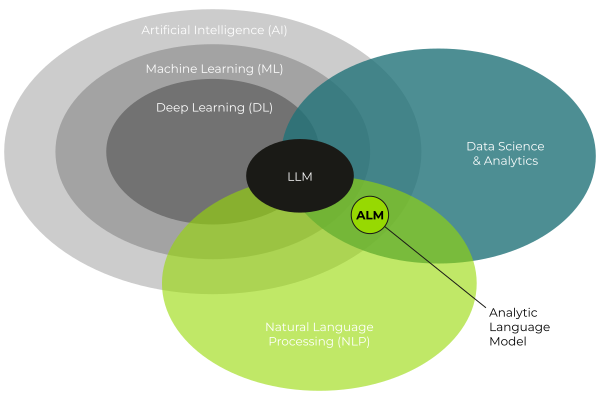
Most language tools process text. The Analytic Language Model (ALM) goes further: it maps meaning, tracks how it shifts over time, and makes the invisible dynamics of organizational communication visible.
At the heart of Step 3 “Capture the Essence” sits the ALM. Developed together with Dr. Klaus Holthausen, who has applied these methods in brand positioning for decades, the ALM sits at the intersection of LLM, Natural Language Processing, and Data Science. It ingests any text-based source – speeches, surveys, intranets, newsletters – and returns structured insight into where an organization stands in its transformation journey.
The result: a living picture of communication that can be read, compared, and acted upon.
You are leading change.
You choose your words carefully.
You talk about innovation, leadership and cultural transformation.
But here is the challenge: The words may be the same. Their meaning for your team may not be.
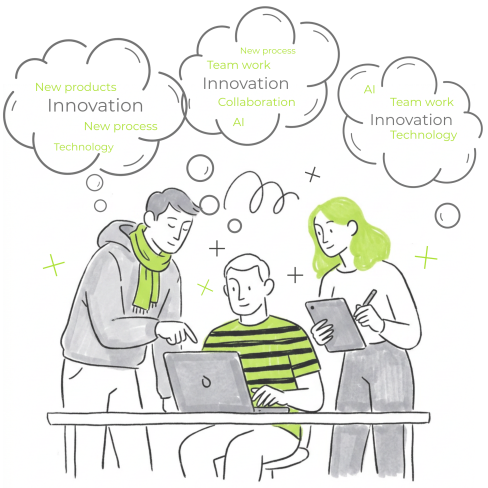
What you as a leader mean by “innovation” is not always what others understand, because words do not travel alone. They carry associations, experiences, expectations, and learned behavior.
1. Define the Objective
Every analysis starts with a precise question. Think of it as a strategic investigation. You begin with a hypothesis.
For example:
Which concepts and words are most closely associated with “innovation” in your team? Did you speak about innovation differently in the past than you do today?
This is where we define what we want to know, and need it to be understood. Together, we define the right question for your analysis. For now, let’s start with one simple example: What associations surround “innovation” today, and how have those associations changed over time?
This is only one example of the many questions you can explore through the semantic analysis process.
2. Generate your Data Basis
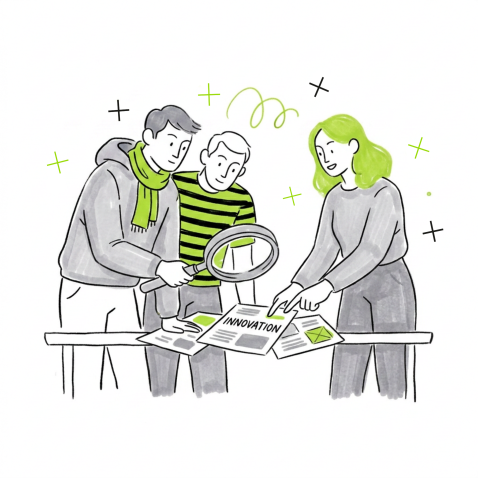
Now you collect the real language of your organization.
Not assumptions but the actual words people use everyday.
This can include:
This creates the foundation for the analysis. If you want to understand how meaning is formed, you need to start with how people actually speak, write, and describe their world:
Where do you find real self-expression in your organization?
That is where the analysis gets valuable.

3. Capture the Essence – Define your Semantic Nexus
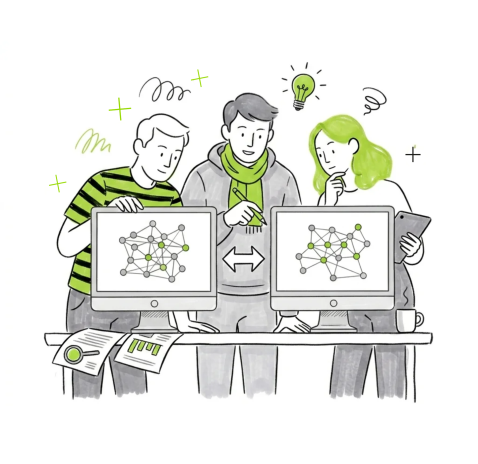
With a Semantic Nexus you map how words connect across texts, topics, and contexts. This reveals recurring patterns, hidden associations or different meanings behind the same term.
In other words, you begin to understand what “innovation” actually means inside your organization – not in theory, but in data.
This is your Semantic Nexus.
It makes meaning visible.
It shows you how concepts are connected in people’s minds.

4. Compare & Contrast – Where are the gaps?
Once the Nexus are in place, you can compare perspectives.
Look at how key concepts are understood across different groups, contexts, and points in time, like:
This is where gaps become visible, where communication creates alignment and where it creates confusion, friction, or drift.
Because transformation does not only slow down when strategy is unclear. It also slows down when the same word means different things to different people.
5. Translate into Action
Your last step is to turn insight into direction.
Now that you understand how “innovation” is interpreted across your organization, you can place those insights into the bigger picture of your transformation.
Semantic analysis does not end with identifying patterns, gaps, or tensions in language. Its real value lies in what you do next.
Use these insights to sharpen key messages, align communication across teams and channels, strengthen narrative consistency or support your broader transformation direction.
By embedding the findings into the larger transformation narrative, your communication becomes more intentional, more consistent, and more effective.
This is where understanding moves people.
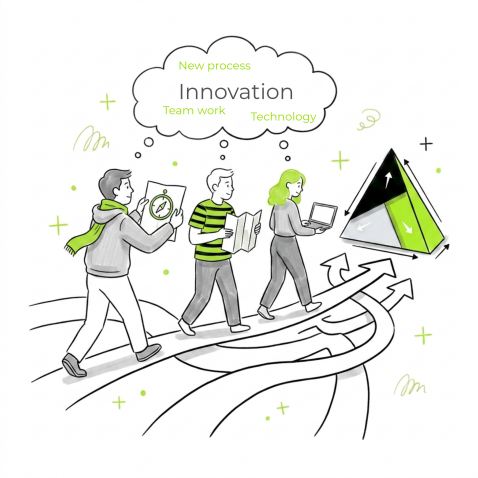
We combine expertise from transformation, storytelling, semantics, mathematics, and technology – turning language insights into practical steps that drive clearer communication and stronger alignment across organizations.
onto[story] GmbH brings deep expertise in strategic transformation, storytelling, and behavior change – with a sharp eye for how organizations actually communicate, not just how they intend to. They are the driving force behind Semantic Analysis, connecting language data with what makes transformation succeed or fail in practice.
Dr. Klaus Holthausen, a true pioneer in AI, developed a patent for a neural internet search engine as early as 1998, emerging from research at the University of Jena. His concept of the Digital Genome forms the scientific and mathematical foundation of our Analysis Language Model.
N+B IT GmbH is an experienced full-service IT partner with strong expertise in software development, custom backend solutions, and rapid prototyping. They provide the technical infrastructure needed to bring the ALM from concept into reliable, real-world application.